
AI can make research less confusing, but it should support your thinking rather than replace it. Used well, it can help you narrow a topic, understand unfamiliar terms, organize sources, compare arguments, and plan an assignment. Used carelessly, it can lead you toward invented references, inaccurate summaries, privacy problems, or work that does not meet your course rules.
This guide shows how students can use AI for research in 2026 while keeping the important work in human hands. You will get a practical workflow, prompts you can adapt, a verification checklist, and clear guidance on academic integrity and privacy.
What AI Is—and Is Not—Good for in Student Research
Think of an AI assistant as a brainstorming partner, explainer, and organizer. It can help you explore possibilities quickly. It is not an authority, a database record, or proof that a claim is true.
That distinction matters because an AI system can produce a fluent answer that contains the wrong date, misreads a source, leaves out an important viewpoint, or cites something that does not exist. OpenAI’s own guidance says ChatGPT can produce incorrect facts and fabricated references, and recommends checking important information against reliable sources. Search citations are useful starting points, but even cited search results can be incomplete or wrong.
A safe rule is simple: use AI to improve your research process, then use original sources to support your assignment.
Choose the Right Type of AI Tool
You do not need every tool. Choose one that fits the stage of your work, and check whether your school allows it.
Web-connected assistants for finding leads
A web-connected assistant can suggest search terms and locate potentially useful pages. For example, ChatGPT Search can return current web information with links to sources. Google Gemini may show related sources with some responses, and Microsoft Copilot Chat can be grounded in public web information for eligible school accounts.
These links are leads, not finished evidence. Open each one, identify the author or organization, check the publication date, and confirm that the page actually supports the claim.
Source-grounded notebooks for working with material you provide
Source-grounded tools are useful after you have collected credible material. Google’s Gemini Notebook lets users ask questions about selected sources and provides citations back to passages in those sources. It can also turn source material into flashcards or quizzes. Microsoft’s Study and Learn Agent can use uploaded files as context and show citations to the source for eligible education accounts.
Availability, age requirements, school settings, and usage limits can change. Treat the controls visible in your account—and your institution’s policy—as the final word.
A Safe AI Research Workflow for Students
1. Turn a broad subject into a researchable question
Start with your assignment instructions, not the AI tool. Note the required length, source types, deadline, citation style, and whether AI use is allowed. Then ask for possible angles instead of asking for a complete essay.
Prompt: I am researching [broad topic] for a [course level] assignment. The task requires [requirements]. Give me six focused research questions. For each, explain what evidence I would need and one reason the question may be too broad or too narrow. Do not write the assignment.
Choose a question you can investigate with the time and sources available. Rewrite it in your own words so you understand exactly what you are asking.
2. Build vocabulary before searching
Research becomes easier when you know the language specialists use. Ask the AI to explain key concepts, related terms, older terminology, and likely disagreements. This can reveal better keywords for your library catalogue or academic database.
Prompt: Explain [concept] at an introductory college level. Define five important terms, show how they relate, and give me alternative keywords I could use in an academic database. Flag anything that experts may define differently.
Do not cite this explanation as evidence. Use it to prepare for reading reliable material.
3. Create a search plan, not a made-up bibliography
Ask for search strings and source types rather than a list of references from memory. A useful plan might include a primary source, a recent review, an official dataset, and a credible counterargument.
Prompt: Help me create a source-finding plan for this question: [question]. Suggest search phrases, useful source types, likely primary sources, and organizations that may publish trustworthy material. Do not invent titles, authors, or citations.
Run those searches in your library tools, subject databases, Google Scholar, or relevant official websites. If you use an AI search feature, follow every promising link to the publisher’s page.
4. Organize sources with a research matrix
A simple matrix prevents sources from blending together. Create columns for the full citation, source type, research method, central claim, evidence, limitations, useful quotations with page numbers, and how the source relates to your question.
Prompt: Using only the source notes I paste below, create a research matrix with these columns: source, main claim, evidence, method, limitations, connection to my question, and follow-up questions. Write “not provided” when the notes do not contain an answer. Do not add outside facts.
Compare the output with your notes before saving it. Keep the original PDF, webpage, or book details beside the matrix.
5. Summarize material you have actually read
AI can help unpack a dense passage, but a summary is only useful when it stays faithful to the source. Work with material you are allowed to upload, and provide a specific task.
Prompt: Summarize the passage below in five bullet points for a student new to the topic. Separate the author’s claims from the evidence. Preserve qualifications such as “may,” “in this sample,” and “under these conditions.” Do not add information that is absent. Afterward, list three details I should verify in the original.
Read the relevant pages yourself. Check names, numbers, dates, causal claims, and the context around any quotation. An AI summary should never become a substitute for the original source.
6. Compare information without forcing agreement
Research often involves sources that use different definitions, samples, methods, or time periods. Ask the AI to map those differences instead of declaring a winner.
Prompt: Compare Source A and Source B using only the notes below. Identify agreements, disagreements, differences in method or scope, and questions neither source answers. Do not decide which is stronger unless the notes provide enough evidence; explain the criteria you use.
When the result says two sources conflict, return to both originals. What looks like disagreement may be a difference in population, measurement, or context.
7. Turn your sources into study questions
Once you understand the material, use AI for active review. Source-grounded tools can make questions from your notes or uploaded readings, but you should still check every answer against the material.
Prompt: Create ten study questions from these notes: four recall questions, four explanation questions, and two application questions. Put the answers in a separate section and cite the heading or page number from my notes for each answer.
Answer without looking first. Then review missed items and correct any faulty question before studying it again.
8. Plan the assignment while keeping the writing yours
AI can help sequence your ideas. Give it your thesis, your own notes, and the evidence you selected; ask for an outline that exposes gaps rather than prose to submit.
Prompt: Review my tentative thesis and source matrix. Suggest a logical outline with a purpose for each section. Mark where I need stronger evidence or a counterargument. Do not draft paragraphs, invent evidence, or change my position without explaining why.
Write the paper yourself. That protects your voice, demonstrates your learning, and makes it easier to explain every claim if your teacher asks.
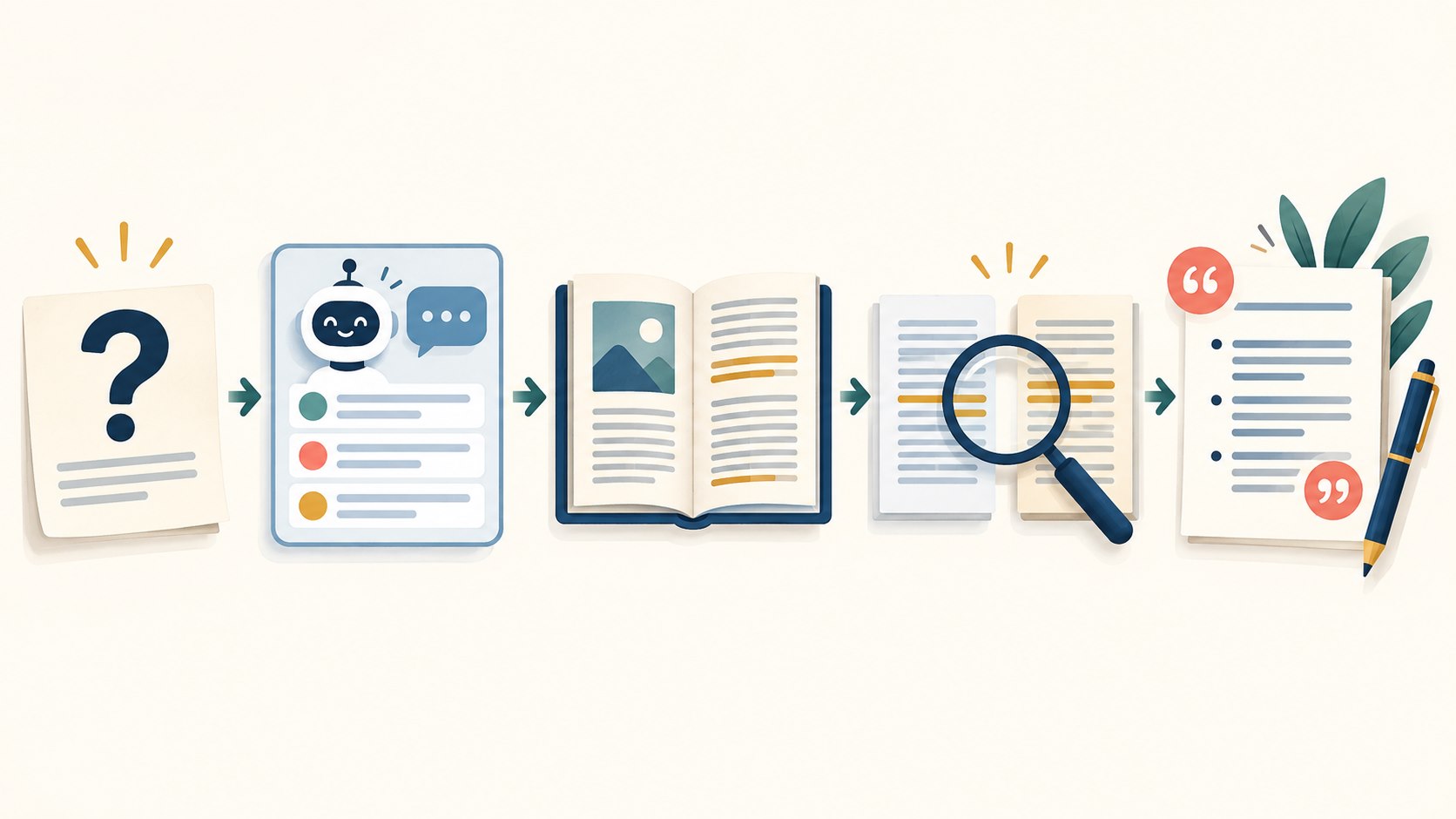
How to Verify AI-Generated Information
Verification is a separate step, not a quick glance at a citation. Use this process for every important factual claim:
- Open the source. A link or citation is not proof that the source exists or says what the AI claims.
- Identify who produced it. Look for the author, publisher, institution, qualifications, and possible conflicts of interest.
- Check the date and version. Current facts can change; historical claims may require sources from the relevant period.
- Find the exact support. Locate the passage, table, dataset, or result. Read enough surrounding context to understand limitations.
- Cross-check consequential claims. Use another independent, credible source—preferably a primary source or authoritative review.
- Record citation details yourself. Save the author, title, publication, date, URL or DOI, page number, and access date as required.
For a quotation, compare every word with the original and record its page or location. For a statistic, check the population, sample, units, date, and definition. For a scientific claim, distinguish a single study from a review or established consensus.
Why Original Sources Still Matter
AI output combines and predicts language; it is not the evidence behind your claim. Original sources let you inspect the full argument, method, data, and qualifications. They also let your reader retrace your work.
Whenever possible, move closer to the evidence. Read the research paper rather than a summary of it, the law or policy rather than a blog post about it, the official dataset rather than a quoted number, and the historical document rather than an AI paraphrase. Secondary sources remain valuable for context and interpretation, but they should not be confused with primary evidence.
If you cannot access the original, say so in your notes and look for a legitimate library copy or another source. Never fill a gap with an AI-generated citation.
Academic Integrity: Keep the Learning Yours
There is no universal rule for acceptable AI use. A teacher may permit brainstorming but prohibit generated sentences; another course may require disclosure; an exam may ban AI completely. Check the assignment, syllabus, and institution policy before you begin. If the rules are unclear, ask.
- Use AI for questions, explanations, organization, and feedback when permitted—not as an invisible ghostwriter.
- Do not submit generated wording as your own work.
- Do not use fabricated or unchecked citations.
- Disclose or cite AI use when your course requires it.
- Keep a research log showing your searches, source decisions, notes, prompts, and revisions.
- Be ready to explain your argument and how each source supports it.
If you want a broader view of available study assistants, see Sensaiteach’s verified overview of AI tools for students in 2026. Always apply your course rules to any tool you choose.
Privacy and Copyright Safety
Before pasting or uploading anything, ask whether you have the right to share it and whether it contains information another person would expect to remain private.
Do not enter passwords, identification numbers, private contact details, medical information, grades, disciplinary records, identifiable information about classmates, confidential interview transcripts, unpublished research, or restricted course materials. Remove names and unnecessary identifiers from your own notes. For group work or interviews, get permission before using anyone else’s words or data.
Use an institution-approved account when one is provided. Managed education tools may have different protections and administrator controls from consumer accounts. Review the service’s current privacy settings and retention information; do not assume every AI product handles uploads in the same way.
Copyright also matters. Upload only material you are allowed to use, and do not ask AI to reproduce large portions of a protected source. Cite the original creator even when an AI tool helped you understand or organize the material.
Common AI Research Mistakes to Avoid
- Starting with “write my paper.” This skips the research and learning the assignment is designed to assess.
- Trusting a polished answer. Clear writing can still contain false or oversimplified claims.
- Citing the AI’s citation without opening it. The source may not exist, may be outdated, or may not support the sentence.
- Uploading everything. More context is not worth exposing personal, confidential, or copyrighted material.
- Letting summaries erase nuance. Check methods, exceptions, uncertainty, and the author’s actual conclusion.
- Using only one perspective. Search for credible counterarguments and sources from relevant communities.
- Losing track of sources. Maintain citation details and page numbers as you work, not the night before submission.
A Final Checklist Before You Submit
- I followed the assignment’s AI policy and disclosed use if required.
- I wrote the final work in my own words and can explain the argument.
- I opened every cited source and verified that it supports my claim.
- I checked quotations, dates, names, statistics, and page numbers against originals.
- I used credible sources appropriate to the subject and included relevant viewpoints.
- I removed private or confidential information before using an AI tool.
- I checked the final citations in the required style instead of trusting generated formatting.
Frequently Asked Questions
Can I cite an AI chatbot as a research source?
Follow your required citation style and course policy. In most research tasks, the stronger practice is to cite the original books, papers, datasets, or official pages that support your claims. If your assignment specifically analyzes AI output, preserve the conversation and cite or describe it as instructed.
Is an AI summary enough if it includes citations?
No. Citations help you locate evidence, but you still need to open the source, read the relevant section, and confirm that the summary represents it accurately and in context.
Can AI help me find a research topic without cheating?
Often yes, if brainstorming is allowed. Ask for possible questions, keywords, and feasibility checks, then choose and refine the question yourself. Do not ask the tool to complete restricted parts of the assignment.
What should I do if AI gives me a source I cannot find?
Do not cite it. Search the exact title, author, DOI, or publication independently. If it cannot be verified through a credible catalogue, database, or publisher, treat it as unreliable and find a real source.
Use AI to Strengthen Your Process, Not Replace It
The safest way to use AI for research is to give it a limited job: help you ask better questions, understand difficult material, organize what you found, and test your knowledge. Your responsibility is to select credible evidence, read the originals, verify every important claim, protect private information, and produce work that honestly reflects your learning.
That approach may feel slower than generating an instant answer. It produces something far more valuable: research you understand, can defend, and can build on.